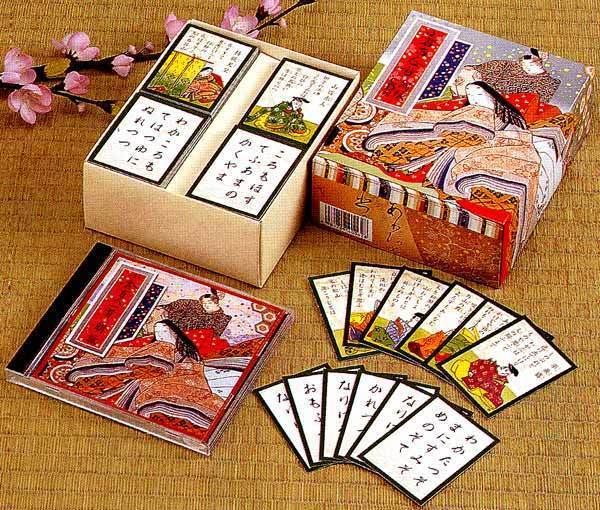
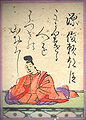
Hyakunin Isshu (百人一首) is a classical Japanese anthology of one hundred Japanese waka by one hundred poets. Hyakunin isshu can be translated to "one hundred people, one poem [each]"; it can also refer to the card game of uta-garuta, which uses a deck composed of cards based on the Hyakunin Isshu.
The most famous and standard version was compiled by Fujiwara no Teika (1162–1241) while he lived in the Ogura district of Kyoto. It is therefore also known as Ogura Hyakunin Isshu (小倉百人一首).
Compilation
One of Teika's diaries, the Meigetsuki, says that his son Tameie asked him to arrange one hundred poems for Tameie's father-in-law, Utsunomiya Yoritsuna, who was furnishing a residence near Mount Ogura; hence the full name of Ogura Hyakunin Isshu. In order to decorate screens of the residence, Fujiwara no Teika produced the calligraphy poem sheets.
Hishikawa Moronobu (1618–1694) provided woodblock portraits for each of the poets included in the anthology. Katsukawa Shunshō (1726–1793) designed prints for a full-color edition published in 1775.
In his own lifetime, Teika was better known for other work. For example, in 1200 (Shōji 2), he prepared another anthology of one hundred poems for ex-Emperor Go-Toba, called the Shōji Hyakushu.
Poets
Poems
Poem number 1
A poem by Emperor Tenji about the hardships of farmers. Teika chose this poem from the Gosen Wakashū:
秋の田のかりほの庵の苫をあらみ
わが衣手は露にぬれつつ
aki no ta no kariho no io no toma o arami
waga koromode wa tsuyu ni nuretsutsu
In autumn paddies under the temporary dwelling made of rushes, my sleeves are wet with the dew.
(Gosen Wakashū 6:302)
Poem number 2
A visually-descriptive poem attributed to Empress Jitō. Teika chose this poem from the Shin Kokin Wakashū:
春過ぎて夏来にけらし白妙の
衣干すてふ天の香具山
haru sugite natsu kinikerashi shirotae no
koromo hosu chō Ama no Kaguyama
Spring has passed, and the white robes of summer are being aired on fragrant Mount Kagu—beloved of the gods.
(Shin Kokin Wakashū 3:175)
The original was likely based from a poem of the Man'yōshū (book 1, poem 28) by the same poet.
Poem number 26
A quite different poem is attributed to Sadaijin Fujiwara no Tadahira in the context of a very specific incident. After abdicating, former Emperor Uda visited Mount Ogura in Yamashiro Province. He was so greatly impressed by the beauty of autumn colours of the maples that he ordered Fujiwara no Tadahira to encourage Uda's son and heir, Emperor Daigo, to visit the same area.
Prince Tenshin or Teishin (貞信公, Teishin-kō) was Tadahira's posthumous name, and this is the name used in William Porter's translation of the poem which observes that "[t]he maples of Mount Ogura / If they could understand / Would keep their brilliant leaves / until [t]he Ruler of this land / Pass with his Royal band." The accompanying 18th century illustration shows a person of consequence riding an ox in a procession with attendants on foot. The group is passing through an area of maple leaves.
Teika chose this poem from the Shūi Wakashū for the hundred poems collection:
小倉山峰のもみぢ葉心あらば
今ひとたびの行幸またなむ
Ogura-yama mine no momijiba kokoro araba
ima hitotabi no miyuki matanan
Maple leaves on Ogura mountain: if you had a heart, I would have you wait for one more royal visit!
(Shūi Wakashū 17:1128)
Poem number 86
A poem by Saigyō about the pain of love. This poem was chosen from the Senzai Wakashū:
嘆けとて月やは物を思はする
かこち顔なるわが涙かな
nageke to te tsuki ya wa mono wo omowasuru
kakochi-gao naru waga namida ka na
How could the moon make me fall into thought by saying "Lament!"? Although it is attributed to me being in love, I attribute my tears falling down to the moon.
(Senzai Wakashū 15:926)
Order of arrangement of the collection
English translations
The Ogura Hyakunin Isshu has been translated into many languages and into English many times.
English translations include:
- F. V. Dickins, Hyaku-Nin-Isshu, or Stanzas by a Century of Poets (1866)
- Clay MacCauley, Hyakunin-isshu (Single Songs of a Hundred Poets), TASJ, 27(4), 1–152 (1899)
- Yone Noguchi, Hyaku Nin Isshu in English (1907)
- William N. Porter, A Hundred Verses from Old Japan (1909)
- Tom Galt, The Little Treasury of One Hundred People, One Poem Each (1982)
- Joshua S. Mostow, Pictures of the Heart: The Hyakunin Isshu in Word and Image (1996)
- Peter MacMillan, One Hundred Poets, One Poem Each: A Treasury of Classical Japanese Verse (2008; Penguin Classics, revised edition 2018)
- Emiko Miyashita and Michael Dylan Welch, 100 Poets: Passions of the Imperial Court (2008)
- Hideaki Nakano, WAKA WAKA 100 - Hyakunin Isshu (2023)
Other Hyakunin Isshu anthologies
Many other anthologies compiled along the same criteria—one hundred poems by one hundred poets—include the words hyakunin isshu, notably the World War II-era Aikoku Hyakunin Isshu (愛国百人一首), or One Hundred Patriotic Poems by One Hundred Poets. Also important is Kyōka Hyakunin Isshu (狂歌百人一首), a series of parodies of the original Ogura collection.
Card game
Teika's anthology is the basis for the card game of karuta, which has been popular since the Edo period.
Many forms of playing games with Hyakunin Isshu exist in Japan, such as Uta-garuta, the basis for competitive karuta (kyōgi karuta).
See also
- Nisonin, Kyoto
- Shigureden, a museum in Kyoto about this subject
Notes
References
- Fujiwara no Sadaie, Thomas Galt. (1982). The Little Treasury of One Hundred People, One Poem Each. Princeton: Princeton University Press. ISBN 978-0-691-06514-4
- Fujiwara no Sadaie, Yoritsuna Utsunomiya, William Ninnis Porter. (1979) A Hundred Verses from Old Japan, Being a Translation of the Hyaku-nin-isshiu: Being a Translation of the Hyaku-nin-isshiu. Tokyo: Tuttle Publishing. ISBN 978-4-8053-0853-0
- Mostow, Joshua S., ed. (1996). Pictures of the Heart: The Hyakunin Isshu in Word and Image. Honolulu: University of Hawaii Press. ISBN 978-0-8248-1705-3; OCLC 645187818
- 新総合 図説国語 新訂版, 東京書籍株式会社, (2016), 池内輝雄・三角洋一・吉原英夫, ISBN 978-4-487-36125-0 SINSOUGOU ZUSETSUKOKUGO revised edition, TOKYO SHOSEKI CO., LTD.(2016), Teruo Ikeuchi・Youichi Misumi・Hideo Yosiwara.
- 古語辞典 第十版, 旺文社, (2008), 松村明・山口明穂・和田利政, ISBN 978-4010721193 KOGOZITEN 10th edition, OBUNSHA(2008), Akari Matsumura・Akiho Yamaguchi・Toshimasa Wada.
- 全訳古語辞典 第四版, 旺文社, (2011), 宮腰賢・石井正己・小田勝, ISBN 978-4010777183 ZENYAKU KOGOZITEN 4th edition, OBUNSYA(2011), Masaru Miyakoshi・Masami Ishii・Masaru Oda
Further reading
- One Hundred Poets, One Poem Each: A Translation of the Ogura Hyakunin Isshu, Peter McMillan, foreword by Donald Keene. New York: Columbia University Press, 2008. ISBN 978-0-231-14398-1
- One Hundred Poets, One Poem Each: A Treasury of Classical Japanese Verse, Peter McMillan. London: Penguin Classics, 2018. ISBN 9780141395937
- 100 Poets: Passions of the Imperial Court, Emiko Miyashita and Michael Dylan Welch, translators. Tokyo: PIE Books, 2008. ISBN 978-4-89444-757-8 This book is also available as an iPad/iPhone application.
External links
- Works on the topic Hyakunin Isshu at Wikisource, with English translations of each poem
- Works related to Hyakunin Isshū at Wikisource, with links to published English translations
- Ogura Hyakunin Isshu
- Ogura Hyakunin Isshu - 100 Poems by 100 Poets at University of Virginia Library Japanese Text Initiative
- Ogura Hyakunin Isshu public domain audiobook at LibriVox
![Hyakunin isshu [Ogura hyakunin isshu] [Page 170] Hyakunin isshu [Ogura](https://www.alamy.com/aggregator-api/download?url=https://c8.alamy.com/comp/FERCYJ/hyakunin-isshu-ogura-hyakunin-isshu-page-170-hyakunin-isshu-ogura-FERCYJ.jpg)